Faculty Spotlight
Dr. Chris Amato, Assistant Professor
How should a team of robots make good decisions together with limited sensing, and unreliable communication? This deceptively simple question sits at the center of the research program of Christopher Amato, associate professor in the Khoury College of Computer Sciences, affiliated faculty in Electrical and Computer Engineering, and a core faculty member at Northeastern’s Institute for Experiential Robotics (IER).
Amato directs the Lab for Learning and Planning in Robotics (LLPR), where his team develops planning and reinforcement learning methods for systems of agents operating under partial observability and limited communication. His work spans artificial intelligence, machine learning, and robotics, unified by a single ambition: principled, scalable algorithms that let robots, sensors, and software agents coordinate well when no single agent can see the full picture. Since joining Northeastern in 2016, after a research scientist position at MIT CSAIL with Leslie Kaelbling and Jonathan How, Amato has built one of the most productive multi-agent RL groups in the country, with more than 8,900 citations and recognition by Stanford’s Top 2% Most-Cited Scientists list.
Research Foundations: Coordination Without a Central View
Most reinforcement learning research assumes a single agent that sees everything. Real deployments rarely look like that. Search-and-rescue drones, warehouse fleets, and autonomous vehicles each see only their immediate surroundings; their teammates’ and their corresponding information are usually hidden. The standard model for this regime is the Decentralized Partially Observable Markov Decision Process (Dec-POMDP), and Amato has been one of its central developers. His 2016 Springer book with Frans Oliehoek, A Concise Introduction to Decentralized POMDPs, is a standard reference, and he is a contributing author of the 2015 MIT Press textbook Decision Making Under Uncertainty.
His 2017 ICML paper “Deep Decentralized Multi-task Multi-Agent Reinforcement Learning under Partial Observability” is now a foundational reference on deep multi-agent RL, with 800 citations. It introduced a decentralized learning approach robust to the non-stationarity teammates’ concurrent exploration creates, and showed how to distill single-task policies into a unified policy generalizing across related tasks without explicit task identity.
Coordination in the Real World
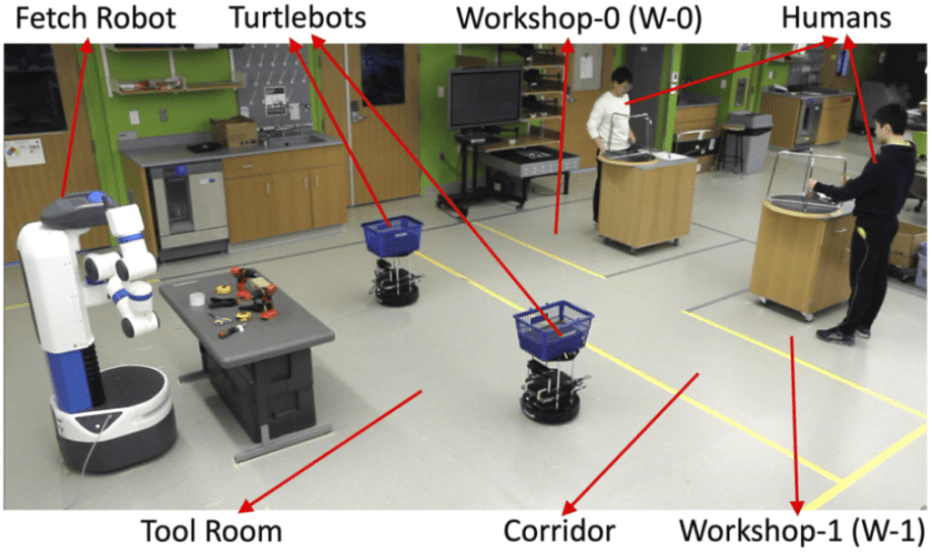
Amato’s research has consistently moved between theory and deployment. While at MIT, his team’s work on multi-robot coordination under uncertainty, including a demonstration of robots optimizing beer delivery, was covered by MIT News, the Boston Globe, Popular Science, and IEEE Spectrum. The underlying contribution, hierarchical macro-actions, scaled Dec-POMDP solutions from toy problems to coordinated quadrotor fleets handling realistic delivery and search tasks.
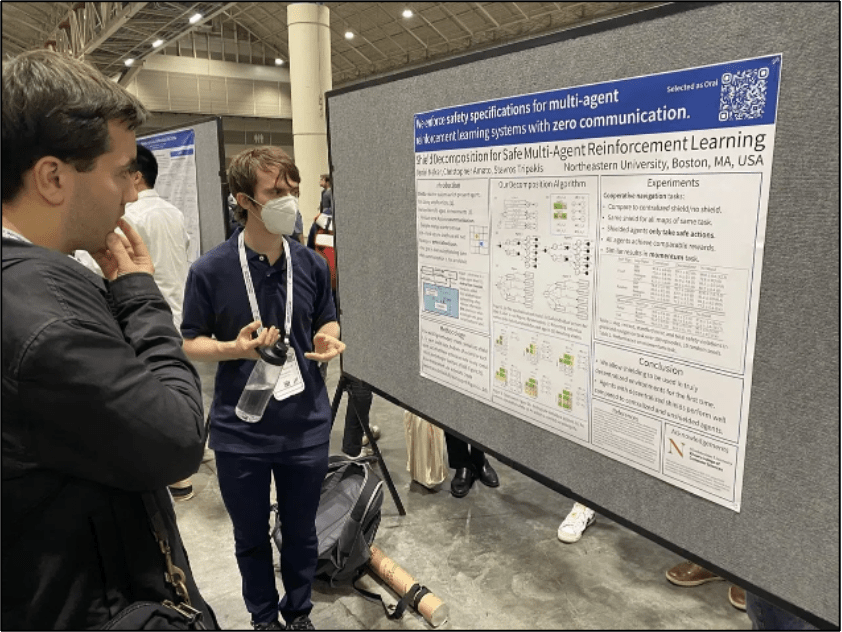
That arc continues at Northeastern. Recent LLPR work includes further improvements to multi-robot coordination for long-horizon real-world tasks (IJRR 2025) and foundational contributions on the Centralized Training for Decentralized Execution (CTDE) paradigm — including work demonstrating that a number of widely used methods were incorrect or misunderstood (JAIR 2023). Recent work has also turned to safety and adversarial robustness: shield decomposition for safe RL in multi-agent partially observable environments (RLJ 2024), “SleeperNets” (NeurIPS 2024) on backdoor poisoning attacks against deep RL, and adversarial inception backdoor attacks (ICML 2025).
Most recently, the lab has extended its multi-agent framework to teams of large language models with multi-agent reinforcement learning algorithms for training LLMs to collaborate (AAAI 2026, ICML 2026).
Recognition
Amato received the NSF CAREER Award in 2021 for his work on multi-agent reinforcement learning, along with Amazon Research Awards in 2019, 2020 and 2024. His group has earned a best paper award at AAMAS-14, best paper nominations at RSS-15, AAMAS-21, and MRS-21, and an outstanding student paper honorable mention at AAAI-19 for “Learning to Teach in Cooperative Multiagent Reinforcement Learning.” He co-founded the COMARL seminar series on multi-agent reinforcement learning.
Mentorship and Student Outcomes
LLPR is a large, active group. Current PhD students include Daniel Melcer, Chulabhaya Wijesundara, Rupali Bhati, Ethan Rathbun, Shuo Liu, Michael Lvovsky, and Ahmed Agha, working across deep multi-agent RL, formal verification, adversarial robustness, world models, and LLM-based collaboration. Recent alumni have placed well: Yuchen Xiao (PhD 2022) leads Embodied AI R&D at Unitree Robotics; Hai Nguyen (PhD 2024) is an Applied Scientist at Amazon Robotics; Andrea Baisero (PhD 2025) is a postdoctoral scholar at UC Irvine; Sammie Katt (PhD 2023) is a postdoc at Aalto University. Amato teaches graduate courses in reinforcement learning and decision making under uncertainty at Khoury, pulling students directly into the lab’s research pipeline.

Looking Ahead
As autonomous systems move from single robots in controlled labs to teams operating in warehouses, on roads, and across disaster zones, the questions Amato works on stop being academic. Real fleets cannot rely on perfect communication, complete observation, or a central controller. His research provides the algorithmic foundations that make autonomy under those constraints tractable. Through his theoretical contributions, his lab’s robot demonstrations, and the steady stream of well-placed alumni across industry and academia, Christopher Amato exemplifies Northeastern’s mission of combining rigorous scholarship with real-world impact, helping position the Institute for Experiential Robotics at the forefront of research on multi-agent and multi-robot systems.