Faculty Spotlight
Dr. Derya Aksaray, Assistant Professor
What does it mean for an autonomous robot to be trustworthy? Not just to act, but to act with provable guarantees that it will satisfy its mission, respect safety boundaries, and adapt gracefully when the world fails to cooperate? These questions drive the research of Derya Aksaray, assistant professor in the Department of Electrical and Computer Engineering and a core faculty member at Northeastern’s Institute for Experiential Robotics (IER).
Aksaray directs the Dependable Autonomy Lab (DAL), where her team develops planning, control, and learning algorithms for autonomous robots operating in uncertain, dynamic, and cluttered environments. Her work sits at the intersection of control theory, formal methods, and machine learning, with a unifying goal: building autonomous systems whose behavior comes with mathematical correctness guarantees. Since joining Northeastern in August 2022, after four years at the University of Minnesota and postdoctoral positions at MIT CSAIL and Boston University, Aksaray has built a research program that develops mathematical foundations and algorithmic frameworks for autonomous robots operating under complex missions, uncertainty, and safety-critical constraints.
Research Foundations: Specifying What Robots Should Do
Telling a robot to “patrol the perimeter every fifteen minutes, never enter the restricted zone before checking in with the operator, and return to base if battery drops below twenty percent” is easy in English. Translating that into mathematics a controller can act on is not. Standard equations strain under spatial, temporal, and logical constraints layered on top of one another. Temporal logics, especially Signal Temporal Logic (STL), provide a compact formal language for these layered requirements.
Aksaray’s career has been built on closing the gap between expressive specifications and provably correct controllers. Her 2016 paper “Q-Learning for Robust Satisfaction of Signal Temporal Logic Specifications” was among the first to connect reinforcement learning with temporal-logic-based robot control, enabling autonomous systems to learn policies for complex mission requirements with formal robustness guarantees even when the system dynamics are unknown. Her 2017 Theoretical Computer Science paper “Time Window Temporal Logic” introduced a specification language for describing missions that involve ordered tasks and deadlines. This work made such missions easier to express and interpret while preserving the computational structure needed for efficient planning and control. It also introduced the idea of temporal relaxation, which allows robots to reason systematically about modified versions of a mission when the original timing requirements cannot be met.
Resilient Autonomy When Plans Break
A robot that satisfies its mission only when nothing goes wrong is not, in any practical sense, autonomous. Real environments deny access to regions, push deadlines past their windows, or rearrange obstacles mid-flight. Aksaray’s current research asks: when the environment makes the original mission infeasible, how should a robot replan in a principled way, relaxing its specification just enough to continue while preserving formal guarantees?
This thrust, which her lab calls resilient autonomy, minimally relaxes temporal logic specifications along three axes: spatial objectives, temporal constraints, and logical task structure. Rather than freezing the robot into idle mode while a human rewrites the specification, the framework lets execution continue under a relaxed specification whose deviation from the original is bounded and known. Her 2025 IEEE Robotics and Automation Letters paper with PhD graduate Ali Tevfik Buyukkocak, “Resilient Online Planning for Mobile Robots with Minimal Relaxation of Signal Temporal Logic Specifications,” formalized this idea for online use.
Learning Safely and Planning Under Uncertainty
A second thrust addresses safety-critical autonomy: how can a robot learn a policy without violating constraints during learning itself? Standard reinforcement learning encourages exploration that may include catastrophic actions, unacceptable for drones or autonomous vehicles. Aksaray’s 2021 IROS paper introduced a framework that maintains probabilistic guarantees on constraint satisfaction throughout learning, not just at convergence. Her recent 2026 ACC paper extends this idea to missions whose safety and task requirements can change over time and ensuring that the robot’s learning process remains constrained by those evolving requirements. The earlier work was supported by DARPA’s Defense Sciences Office through the project “Context-Aware Reinforcement Learning with Complex Objectives and Constraints,” on which Aksaray served as a PI.
A third thrust addresses a challenge faced by robots operating in unfamiliar environments: how can a robot complete a high-level mission when it does not yet know what different parts of the world contain? In this line of work, Aksaray’s lab develops methods that allow robots to explore, build probabilistic semantic maps, and plan under temporal-logic mission requirements while retaining theoretical guarantees on correctness and safety. Two recent 2026 ACC papers advance this direction. This work was also supported by an Army Research Laboratory project on continuous contingency planning in off-road environments.
Lab and Teaching
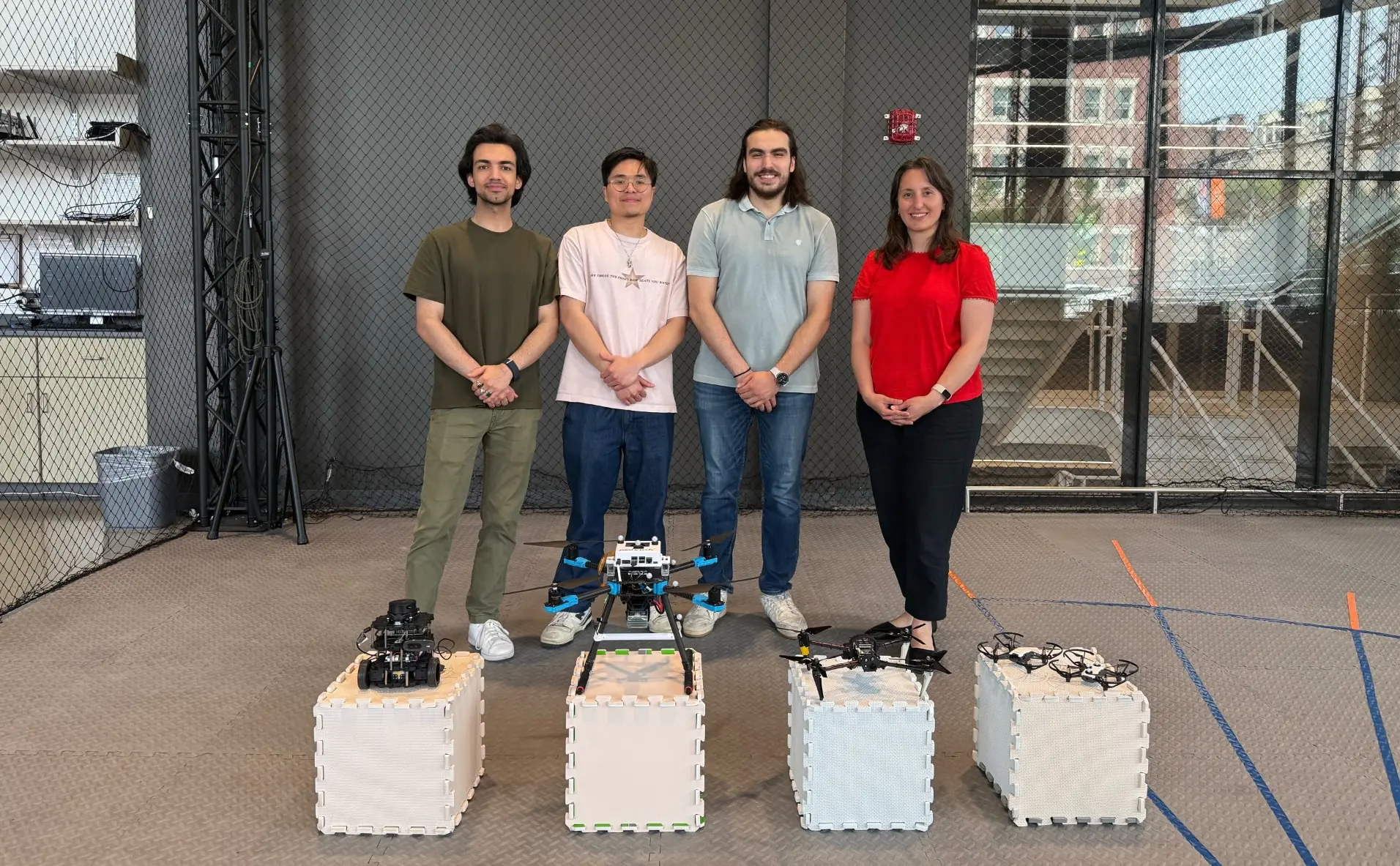
The Dependable Autonomy Lab currently includes PhD students Azizollah Taheri, Bera Yuksel, and Kasidit Muenprasitivej. Aksaray integrates her research into the graduate curriculum, teaching EECE 5550: Mobile Robotics each fall and an upcoming EECE 5555: Formal Methods for Robotics and Control each spring.
Looking Ahead
As autonomous robots move into search and rescue, infrastructure inspection, agricultural monitoring, and defense, the stakes of unreliable autonomy grow with them. Aksaray’s research answers a deceptively simple question: when a robot is given a complex mission and the world does not cooperate, what should it do, and how do we know its choice was correct? Through her research, mentorship, and commitment to bridging theory with deployable robot systems, Derya Aksaray exemplifies Northeastern’s mission of combining rigorous scholarship with real-world impact, helping position the Institute for Experiential Robotics at the forefront of dependable autonomy.