Faculty Spotlight
Dr. Kris Dorsey, Associate Professor
“What if robots could sense the world the way humans do — feeling their own movements, adapting to new situations, and working safely alongside people?” This question drives the research of Dr. Kris Dorsey, Associate Professor with joint appointments in Electrical & Computer Engineering and Physical Therapy, Movement & Rehabilitation Sciences, and a core faculty member at Northeastern’s Institute for Experiential Robotics (IER).
Dorsey leads the PARSES Lab, where her team develops soft robotics and wearable sensing technologies that address a fundamental challenge: how can robots made of flexible materials sense and control their own movements? By folding soft elastomers into origami-inspired structures, her group is creating robots and devices that can “feel” from within — enabling new possibilities in rehabilitation, assistive technologies, and human–robot collaboration.
Since joining Northeastern in 2021, after positions at Carnegie Mellon, MIT Media Lab, UC San Diego, and UC Berkeley, Dorsey has established herself as both a technical innovator and a leader in broadening participation in robotics.

Recognition and Awards
Dorsey’s scholarship has earned wide recognition across research and leadership. She is the recipient of a National Science Foundation CAREER Award for her work on origami-patterned sensors that can distinguish bending, twisting, and pressure — creating a new class of “mechanoreceptors” for soft robots.
She has also been honored with the AnitaB.org ABIE Emerging Leader Award (2022) in honor of Denice Denton, and the JMM Emerging Leader Award for her pioneering analysis of DefeXtiles, a 3D-printed textile for wearable electronics. Earlier in her career, Dorsey co-authored a 2020 Nature paper on ultra-sensitive strain gauges for soft machines — foundational research that continues to inform her work on wearable sensing and soft robotics.
Research Impact
At Northeastern, Dorsey and her students are advancing human-scale soft robotics toward real-world applications. Their work spans origami-inspired robots, selective motion sensors, and soft wearable systems that link robotics to healthcare.
Proprioceptive Origami Robots
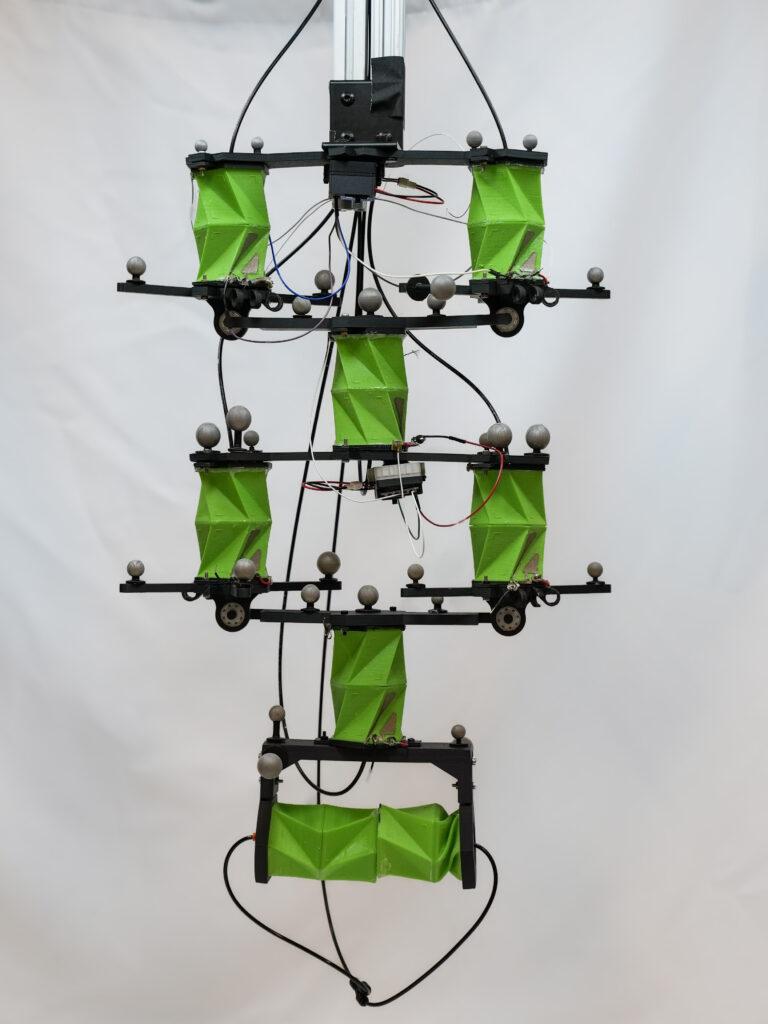
Her lab’s research on air-powered origami structures that can sense and control their own movements gained recognition in 2023 when “Hold ’em and Fold ’em” earned Runner-Up in the Soft Robotics Toolkit Design Competition. This work culminated in the 2024 paper “Controlling the fold: proprioceptive feedback in a soft origami robot” (Frontiers in Robotics & AI), which demonstrates pneumatically actuated origami modules achieving proprioceptive feedback without external cameras.
Smarter, Selective Sensors
In their 2022 paper, “Origami-patterned capacitor with programmed strain sensitivity” (Multifunctional Materials), her team introduced origami-patterned capacitors that respond selectively to different types of motion, solving a long-standing limitation of traditional flexible sensors. These advances point toward “artificial skin” that can be tuned for specific movements critical to health and robotics applications.
Expanding Applications
The PARSES Lab also explores variable-stiffness “jamming” actuation for untethered robots and develops soft capacitive sleeves to monitor limb fluid retention — bridging robotics and healthcare through human-centered design.
Together, these projects strengthen Northeastern’s leadership in developing robots that are not just flexible, but adaptive and responsive to human needs.

Student Success and Educational Integration
Dorsey integrates her cutting-edge research into teaching through EECE 5554: Robotic Sensing & Navigation, preparing students to apply advanced sensing and control concepts to real-world robotics challenges.
Her mentorship has led to outstanding student achievements, including PEAK Experiences Awards for projects like an origami-inspired underwater crawler (COE ’24) and an AJC Merit Research Scholar project on layer-jamming sensors. These successes reflect Northeastern’s experiential learning ethos — where students actively advance research while gaining practical expertise.
Leadership in Building an Inclusive Field
Beyond her technical accomplishments, Dorsey is committed to shaping a robotics field that reflects the diversity of the communities it serves. She is a Senior Member of IEEE, a member of the Materials Research Society, and Co-Director of the Boston Chapter of Black in Robotics, where she mentors students from underrepresented groups in STEM.
Her outreach extends beyond Northeastern through public engagement initiatives designed to make science and technology more accessible. She collaborates with the Museum of Science, Boston, where she appeared in The Future of Robotics: Soft and Flexible — part of the Museum’s Short Science series — introducing audiences to soft robotics built from flexible materials like plastics, rubber, and shape-shifting metals. In this talk, she shared her personal journey in STEM, discussing perseverance, representation, and the human side of engineering.
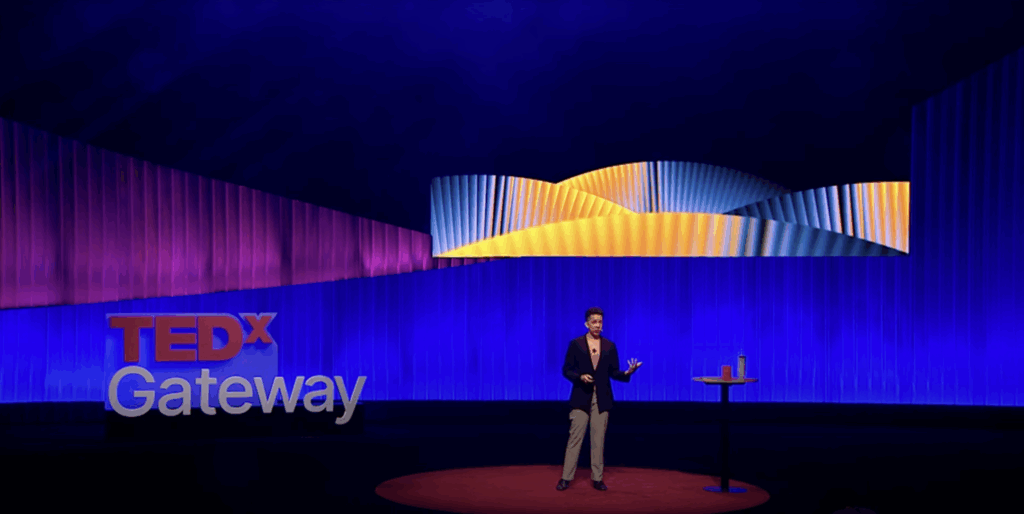
Dorsey’s influence also extends globally. In February 2024, she delivered a TEDxGateway talk in Mumbai titled “Your next favorite outfit might be a robot”, sharing how wearable robotics could one day transform daily life.
Looking Ahead
Through her research innovations, educational leadership, and commitment to equity, Kris Dorsey exemplifies Northeastern’s mission of combining rigorous scholarship with societal impact. As a core faculty member of the Institute for Experiential Robotics, she is helping position Northeastern at the forefront of robotics research that not only advances technology but also serves human needs.
Faculty Spotlight prepared by the Institute for Experiential Robotics, Northeastern University.