Faculty Spotlight
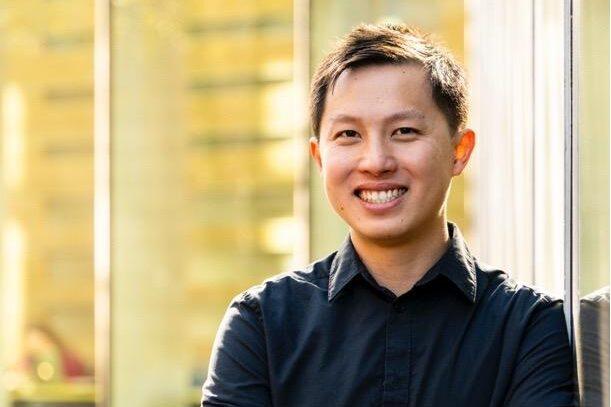
Dr. Zhi Tan, Assistant Professor
Imagine a robotic future where robots are part of our daily lives. Do you think you would only interact with the one robot all the time? What if there was another robot better suited for a particular part of the task, and you need to interact with both robots? What if other digital systems, such as VR glasses or smart home technologies, could enhance the robot’s ability? And how would these robotic systems actually be used to help people in both household and public settings? These questions drive the research of Zhi Tan, assistant professor in the Khoury College of Computer Sciences and a core faculty member at Northeastern’s Institute for Experiential Robotics (IER).
Tan directs the People And Robot Collaborative Systems (PARCS) Lab where he leads research at the intersection of human-robot interaction, artificial intelligence, and assistive technologies. His work addresses a fundamental challenge in robotics: how can multiple robots and intelligent systems work together seamlessly to assist diverse users in real-world environments? Since joining Northeastern in 2023, after completing his postdoctoral fellowship at Georgia Tech as part of the NSF AI-CARING Institute, Tan has established a vibrant research program that bridges foundational robotics research with practical applications that improve people’s lives.
Research Foundations: When One Robot Isn’t Enough
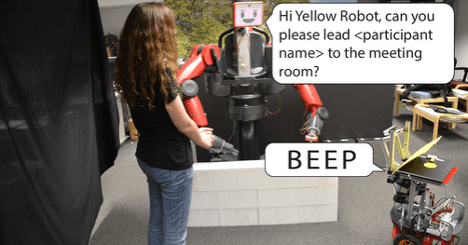
Tan’s research journey began with a simple but profound observation: in most real-world scenarios, a single robot cannot complete every task it encounters. His doctoral thesis at Carnegie Mellon University, “Person Transfers Between Multiple Service Robots,” explored this challenge systematically. Rather than trying to build an all-capable robot, Tan and his collaborators investigated how robots should coordinate when handing off users from one to another—each robot handling the tasks it’s best equipped for.
This work led to the development of a comprehensive taxonomy for sequential human-robot interaction, published at ACM/IEEE HRI 2021 in “Charting Sequential Person Transfers Between Devices, Agents, and Robots.” The taxonomy provides a framework for understanding how people interact with multiple robots in sequence, whether due to capability limitations, efficiency considerations, or service requirements. In a HRI 2019 paper, “From One to Another,” Tan and his collaborators demonstrated how robot-to-robot communication affects user perceptions during these transitions—discovering, for instance, that people prefer robots treating each other the same ways as humans. In their ACM ICMI 2022 Paper, “Group Formation in Multi-Robot Human Interaction During Service Scenarios”, they demonstrated how humans conform to group formations when interacting with multiple robots, even when the robots violate human social norms.
Even at Northeastern, his lab continues to do foundational research in how people interact with multiple robots. In a recent HRI 2026 paper, “Meet My Sidekick!: Effects of Separate Identities and Control of a Single Robot in HRI”, they demonstrated how users can be convinced to treat a single robot as two separate robots and assign blame to part of the robot.
Building on this foundation, Tan conducted field studies to observe how these interactions play out in uncontrolled, real-world environments. In a 2024 paper, “Person Transfer in the Field,” they deployed two robots—one stationary, one mobile—in a public setting over four days, capturing 18 instances of person transfers involving more than 40 individuals. The study revealed insights about handovers, trust dynamics, and the importance of robot positioning that could only be discovered through real-world deployment.
“Something I say about robotics is, you can do 90% of it in the lab,” Tan explains. “The last 10% is the world. You have to take it outside and just try.” The desire to evaluate his system in the world continue drives his lab’s research.
Building Robots on Campus: The West Village H Project
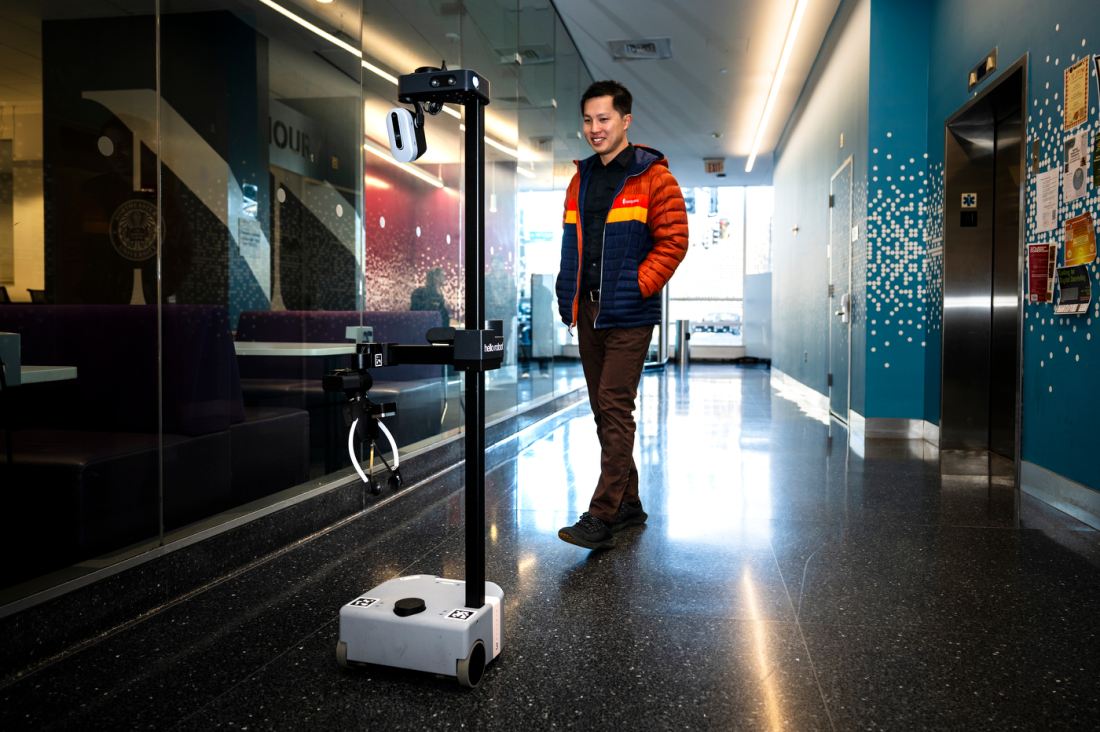
At Northeastern, Tan and his lab are turning the West Village H building—home to Khoury College classrooms and study spaces—into a living laboratory for robot learning. His team is training “Cedar,” a Hello Stretch 3 robot, to become a helper robot in the building. With its mobile base, camera sensors, and gripper arm equipped with large language models and movement recognition capabilities, Cedar is learning to navigate the first floor, guide people to bathrooms and exits, and eventually assist students with tasks like filling water bottles.
The project embodies Northeastern’s experiential learning model. Co-op students like Arushi Aggarwal, Percy Masetti Zanini, and Emily Taylor work directly with Tan, writing and adjusting Cedar’s code in response to real-world data. “This has definitely been my first proper CS job, where I’m applying things I’ve learned in class,” says Percy Zanini. The students are gaining firsthand experience with the challenges of building robust robot systems—from programming Cedar to navigate elevators (still a work in progress) to handling the unpredictability of human behavior.
The long-term vision extends beyond simple navigation tasks. Tan hopes to deploy multiple robots on different floors of the building, testing out how people will receive service from different robots in the real world. He is also exploring how robots can distinguish between people with different needs and disabilities, adjusting behavior accordingly to make the campus more accessible.
AI-CARING: Supporting Independent Aging
As a postdoctoral fellow at Georgia Tech from 2022 to 2023, Tan was part of the NSF AI Institute for Collaborative Assistance and Responsive Interaction for Networked Groups (AI-CARING), a five-year, $20 million initiative. His work focused on developing AI technologies to help older adults live independently at home.
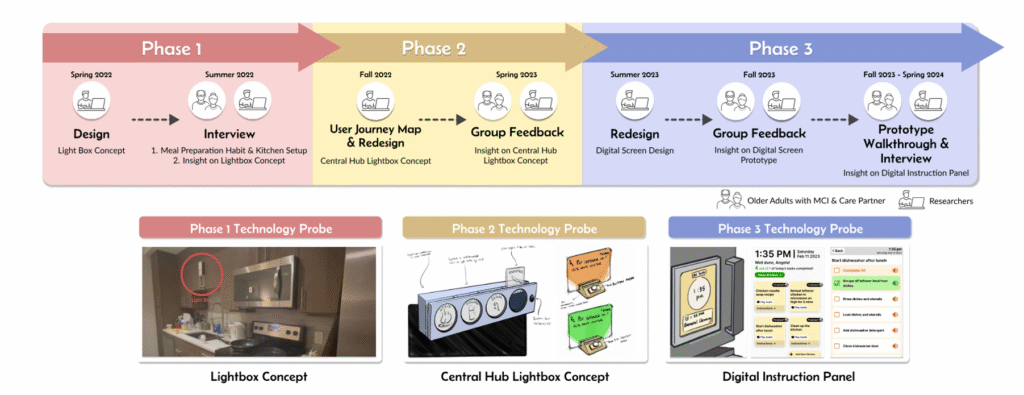
This research continues at Northeastern, where Tan and his team are exploring how context-aware assistive technologies can support meal preparation—a complex activity that becomes increasingly challenging for older adults. This is significantly more challenging for older adults with Mild Cognitive Impairment. In their 2025 paper published in the ACM Designing Interactive Systems Conference (DIS), “Insights from Designing Context-Aware Meal Preparation Assistance for Older Adults with Mild Cognitive Impairment and Their Care Partners,” Tan’s team conducted a three-year iterative design study, evolving from simple lightbox prototypes to sophisticated digital systems.
The research identified three critical contexts for designing assistance: routine-based (supporting habitual tasks), real-time (responding to immediate needs), and situational (adapting to changing circumstances). Crucially, the work emphasized the collaborative nature of meal preparation between people with MCI and their care partners, acknowledging that assistance must respect and support these relationships rather than replace them.
Tan is unsatisfied until the system is tested and evaluated by users in real-world settings. As part of AI-CARING and with collaborators across the country, he is leading the deployment of their device at Viridian Towers in Atlanta, GA. They have deployed the system in 2 homes with a plan of scaling up to 10+ homes at the end of the year. The deployment will put to the test the reliability of our context awareness system and how older adults utilize just-in-time situational assistance in household settings.
Student Success and Research Impact
Tan’s commitment to experiential learning extends to his mentorship of undergraduate researchers. Two of his undergraduates received the PEAK Experience Award – Andrew Ge (Fall 2024) and Arushi Aggarwal (Spring 2026). He also worked with Tammer Haddad, an AJC Merit Scholar in Spring 2025, and multiple undergraduate research co-op students since he joined. He has co-authored with 4 of the undergraduate students who worked in his lab.
Tan has published extensively at premier conferences in human-robot interaction and robotics, including ACM/IEEE HRI, ACM ASSETS, ACM ICMI, IEEE IROS, and IEEE RO-MAN. His work spans from fundamental questions about robot-robot communication to practical applications in accessibility and aging. Before joining academia, Tan earned his PhD in Robotics from Carnegie Mellon University in 2021, working under Aaron Steinfeld, and completed his BS in Computer Sciences from the University of Wisconsin-Madison in 2015.
His research has also explored how people perceive and interact with robots in diverse contexts. Collaborations have examined how people anthropomorphize robots they’ve never met (such as Mars rovers), how robots should react when observing unsafe scenarios, how robots can induce bystander intervention when being physically abused, and how assistive robots can help users with visual impairment navigate complex indoor spaces.
Looking Ahead
Tan’s research program continues to expand at the intersection of fundamental robotics research and real-world impact. As robotics moves from controlled laboratory settings into the complexity of homes, hospitals, and public spaces, Tan’s work provides essential insights into how robots can collaborate with each other, with other digital systems, and with diverse users. His research doesn’t just advance the technical capabilities of robots—it ensures that as these technologies enter our daily lives, they do so in ways that respect human needs, support independence, and enhance rather than replace human relationships.
Through his research innovations, student mentorship, and commitment to real-world deployment, Zhi Tan exemplifies Northeastern’s mission of combining rigorous scholarship with experiential learning and societal impact. As a core faculty member of the Institute for Experiential Robotics, he is helping position Northeastern at the forefront of human-robot interaction research that serves human needs while advancing the field.